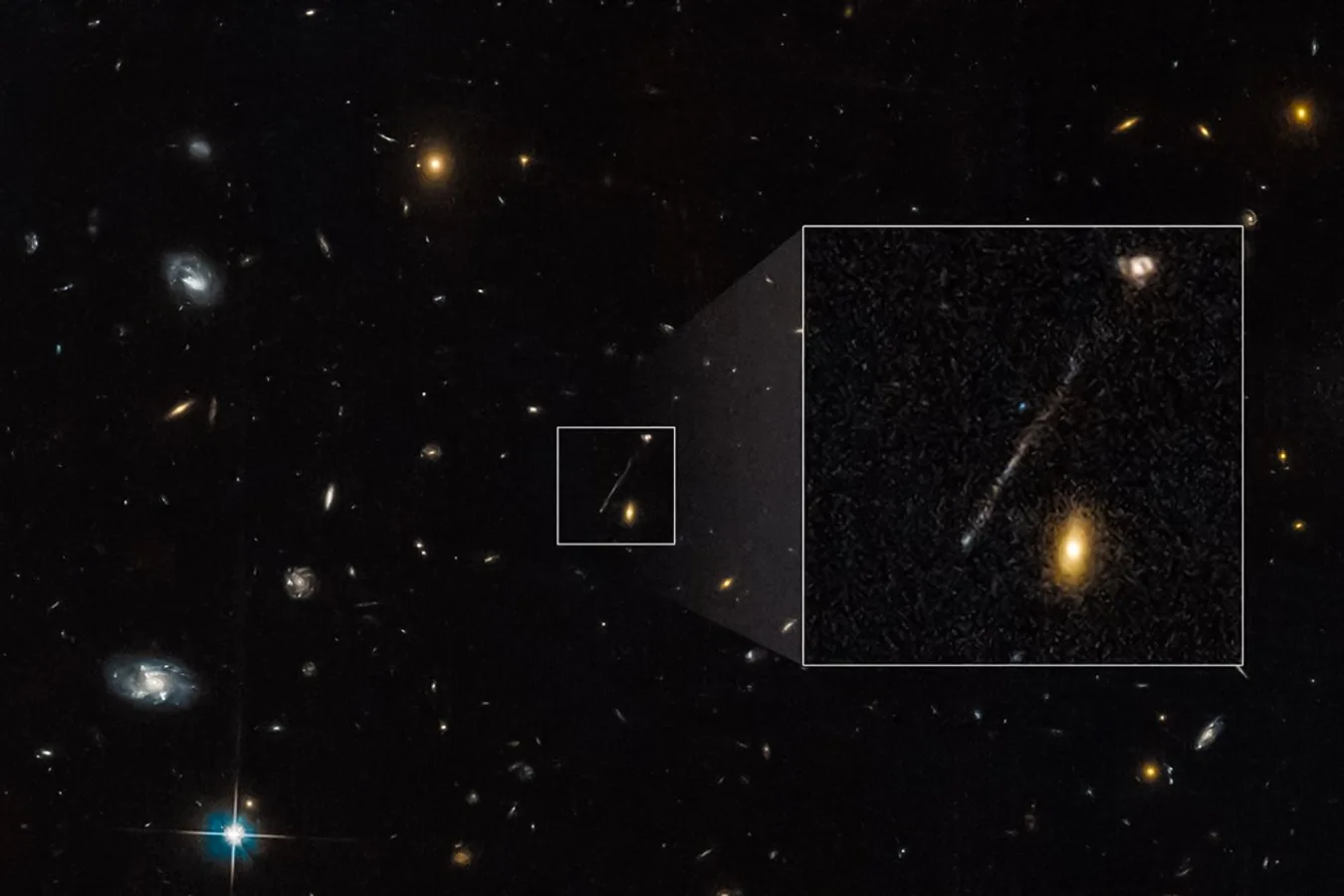
Two supermassive black holes smashing together can create another supermassive black hole that recoils at such high speeds that it launches out of its galaxy. Though this would only happen in rare instances, it provides an explanation for the recent possible sighting of such a runaway black hole. In 2023, researchers noticed a thin, line-like shape in an image that the Hubble Space Telescope took of a patch of space about 7.5 billion light years from Earth.
Based on further analysis, including images from the James Webb Space Telescope (JWST) and studying the line’s light, Pieter van Dokkum at Yale University and his colleagues concluded that the line was a consequences of a never-before-seen cosmic event – a supermassive black hole flying out of a galaxy at supersonic speeds and leaving a chain of young stars in its wake. Not everyone agrees with this analysis, but Tousif Islam at the University of California, Santa Barbara and his colleagues have now uncovered what it would take for a supermassive black hole to behave this way. Advertisement Informed by observations and large-scale simulations of the universe, the team built a mathematical model that could take the idea and properties of a runaway black hole (RBH) and reveal its origin story.
“It’s similar to fossil analysis, we are working backwards to see what the past looked like,” says team member Digvijay Wadekar at the University of Texas at Austin. The team found that an RBH like the one posited by van Dokkum and his colleagues would have had two parent supermassive black holes, where one was spinning quickly and was six times more massive than the other. These would have violently merged about 70 million years ago, creating a recoiling RBH.
“When we do simulations of binary black hole mergers… almost every time there is a recoil kick, but in most of the cases the recoil kick is much smaller,” says Islam. The team estimated that a large enough recoil to match the proposed RBH could happen in fewer than 10 per cent of black hole mergers. “As a mathematical exercise, it’s very interesting, because the physical mechanism to produce a runaway supermassive black hole is there.
Now, the chances that this happens in reality are very low,” says Jorge Sánchez Almeida at the Institute of Astrophysics of the Canary Islands in Spain. Since 2023, he and his colleagues have argued for a less exotic interpretation of the original images. According to their analysis, the line represents a galaxy, full of star-forming regions, viewed edge-on.
Analysing light from these regions is subtle and it can easily be mistaken for a consequence of a fast-moving RBH, says Sánchez Almeida. He says that several other measurements are consistent with the edge-on galaxy interpretation, including the relationship between the mass of the stars and their rotational velocity, which fits the Tully-Fisher relation, a known fingerprint of a disc-shaped galaxy. The team, however, stands by the RBH view.
“There are competing explanations and this seems like the least unfavourable, or you can call it most favourable,” says Wadekar. Islam says that he learned about the RBH when his university hosted a conference about black holes, and it was speaking with astronomers there that convinced him that its existence and past were compelling to study.









Comentários (0)
Entre ou cadastre-se para comentar.