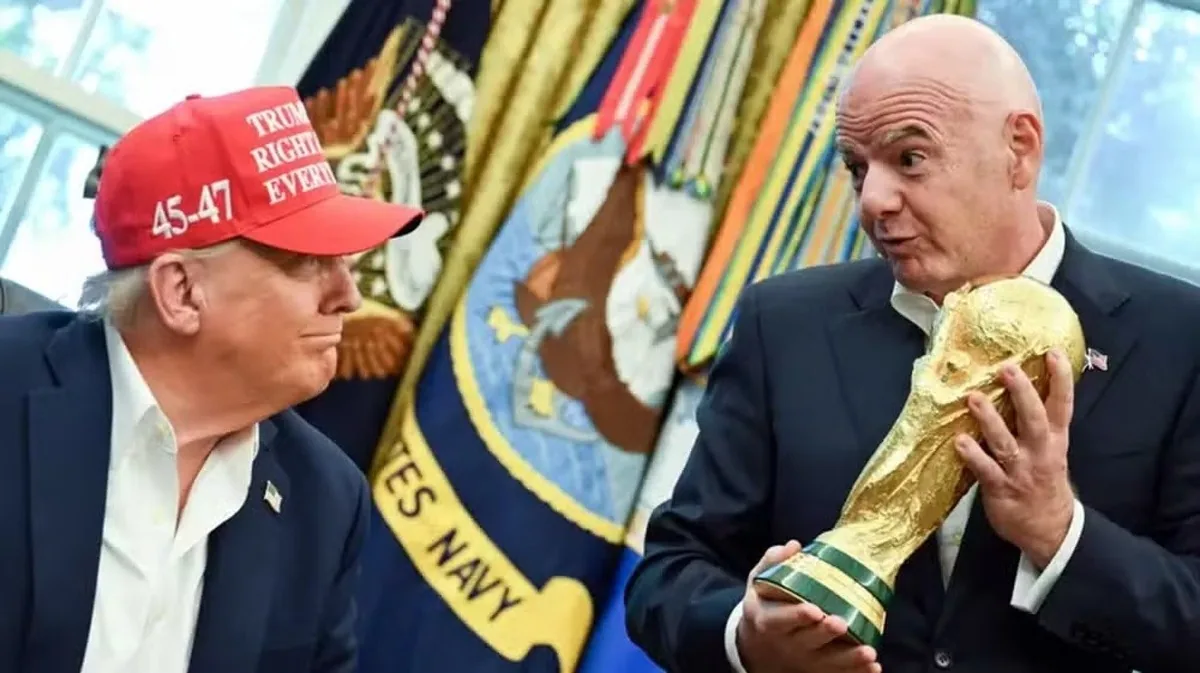
Could football break away from FIFA and its World Cup? July 7, 2026"I'm the one that got them to do it," said Donald Trump on Monday, referring to FIFA’s hugely controversial decision to suspend the red card ban of USA striker Folarin Balogun ahead of their loss to Belgium in the last 16 of the World Cup. The US president then claimed he had just called for a review of the incident, which FIFA and their president, Gianni Infantino, insisted was then ruled upon by their disciplinary committee.
The committee has not ruled on any other decision in a World Cup. Both the reviewing of red cards at the World Cup and political interference of any kind is banned by FIFA’s own statutes. Sky-high ticket prices, the refusals of visas to fans, officials, player’s families and even a referee have all contributed to a tournament in which FIFA, and Trump, have been ever-present.
These issues have all contributed to a spike in unpopularity for an organization that was already disliked by fans, if not necessarily by federations. Infantino, Trump relationship has eroded FIFA trust Several factors have contributed to growing frustration with FIFA. The decision to award US President Trump FIFA's inaugural Peace Prize last December, shortly before Trump started a war with tournament participant Iran, was reportedly a unilateral move by FIFA President Infantino and has further eroded trust both within and outside the organization.
FIFA employ a rotation policy for World Cup hosting — that means each confederation should host a tournament in turn, with the exception of Oceania, which lacks the facilities since Australia began playing in Asian competition. But with matches in the 2030 World Cup scheduled in Europe, Africa and South America, that cleared the way for Saudi Arabia to be awarded the 2034 tournament unchallenged and much earlier than Asia would otherwise have been due, in 2042. With Infantino set to exceed the usual presidential term limit of 12 years, again likely unopposed, frustration with FIFA is at an all-time high, according to many observers.
But can anything be done? How does FIFA maintain its power? FIFA is responsible for the game's global development but also acts as its commercial operator, a system many governance experts have questioned.
The World Cup is its key financial driver, though the recently revamped and expanded Club World Cup is now another key contributor. That competition has led to widespread complaints from players and player unions about a congested calendar that makes unreasonable demands. "I don't think the players are listened to that much, if I'm totally honest," said Bayern Munich and England striker Harry Kane last year.
Structurally, each of the 211 member nations (which sit in six continental federations), gets a single vote for the president every four years. These member associations are then financially rewarded, to a greater or lesser degree, through various schemes and programs. "The commercial dimension is the bedrock of FIFA's system of power.
The money is used by the presidents to accumulate and consolidate their power," Miguel Maduro, a former chairman of FIFA's Governance, Audit and Compliance Committee, told DW.



Comentários (0)
Entre ou cadastre-se para comentar.