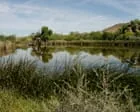
Quitobaquito Springs in south-west Arizona has been called a biological wonderland with few equals. The springs are an oasis in the vast Sonoran desert along the US-Mexico border, held sacred by the O’odham people, who call it A’al Vaipia. Here, water flows out of an aquifer at the bottom of a hill, runs along a short concrete channel and collects in a pond.
The pond is home to Sonoyta pupfish, which are small and silvery, with upturned jaws. In the channel are found small mollusks the size of chia seeds known as springsnails. This is the only place on Earth where these two species live in the wild.
It’s also the only US habitat for the Sonoyta mud turtle, a reptile with a domed shell and the ability to survive amid scarce desert water sources. The spring, located within Organ Pipe Cactus national monument, provides one of the only reliable bodies of water for about 100 miles in any direction, making it vital for wildlife in the area and for humans who have lived here for millennia. But the spring is in trouble.
In 2020, the Trump administration completed a 30ft-tall (9 meters) border wall in this remote area, during which time the spring flow dipped to an all-time low, and the pond partially dried up after its lining cracked. Now, plans are under way to build a second massive section of the wall, just 90-150 feet north of the existing one. That’s despite border crossings in the area being negligible – the vast majority of people who cross into the country in such remote areas intend to be apprehended so they can apply for asylum, immigration experts report.
The planned secondary wall will be made of steel beams, or bollards, also 30ft tall. Similarly designed stretches of secondary or primary fencing are currently under construction at about six other locations on the Arizona-Sonora border, according to Erick Meza, borderlands coordinator with the Sierra Club. “I’ve never seen something of this magnitude,” Meza said.
“It’s unbelievable.” Researchers, environmentalists and Indigenous leaders warn the project will cause untold damage to this fragile, remote wilderness and the animals that call it home. The southern edge of the pond lies 190ft from the border with Sonora, meaning part of the pond would likely be destroyed by heavy machinery necessary for putting up the barrier. Even closer to the line is a grove of mesquite trees, which is part of the federally recognized critical habitat for the mud turtle, where the animals often burrow.
That would likely be leveled by construction. Putting up a second wall in this place could be catastrophic, said Tara Harris, director of conservation and science at the Phoenix Zoo, who fears the planned construction “could destroy the last remaining habitat for multiple imperiled species”. Illegal immigration in the area of Organ Pipe has been extremely minimal since 2025, according to local residents.
In 2023 and 2024, tens of thousands of immigrants seeking asylum came through the wall into Organ Pipe, showing that this barrier doesn’t stop determined people. But those numbers dwindled to almost nothing after the Biden administration sharply limited asylum-seeking.







Comentários (0)
Entre ou cadastre-se para comentar.