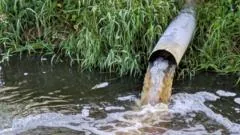
Most sewage spills in England may be illegal, new research suggests - Published Most of the sewage spills into England's waterways in the last two years may have been illegal but gone unpunished, according to new analysis. UK law states that raw sewage should not be released during "normal" weather conditions, yet until now the regulator has not clarified exactly what that means. But campaigner Prof Peter Hammond obtained a definition in secret court papers, and said it shows that for more than 80% of the time sewage was being spilled, the weather was "normal" - making the spills possibly illegal.
The water companies and the regulator, the Environment Agency (EA), rejected the analysis and said they were working to reduce spill numbers. - Failing water sector needs stronger regulation, says damning review - Published3 June 2025 - Record number of illegal sewage spills in Windermere last year - Published31 March 2025 The last few years have seen growing awareness and mounting public anger at the amount of raw sewage that is being discharged into England's rivers, lakes and seas. The country's sewage issues are, in large part, caused by the fact that drains usually take rainfall into the same network of pipes that remove waste from homes.
This means that when it rains, if there is not enough spare capacity, the system and sewage treatment works can be quickly overwhelmed. But until now, it has not been clear what amount of rainfall there must be before water companies can legally spill raw sewage into waterways. Campaigners have said this has allowed the industry to spill routinely with no consequences.
Secret court documents Earlier this year, a source at the EA sent Prof Hammond undisclosed documents from a court case against Southern Water for illegal sewage spilling in 2021. It included a previously undisclosed definition of "heavy rain" conditions. And accompanying internal EA documents confirmed that water companies can spill sewage when there is "heavy" rain i.e.
beyond the "normal" weather conditions. Prof Hammond, a retired academic and campaigner whose work on sewage spills has been cited in Parliament and in economic regulator Ofwat's enforcement decisions, used the definition to run an analysis of water company spill data. He looked at more than 350 storm overflow outlets in England and whether there had been heavy rain when they were spilling sewage.
The outlets include all of the largest sewage treatment works and a representative selection of smaller ones, across all England's nine water companies serving more than 30m people. Hammond said he found about 86% of the raw sewage spilling hours took place when there had not been heavy rain, meaning those discharges could be potentially illegal. None of England's water companies did well in Hammond's analysis, with even the best having a potential illegality rate of over 70% for the last two years.
"It's totally outrageous, both from the point of the water companies who are exploiting the weak regulation but also from the Environment Agency's point of view, where they've not been doing their job properly," Prof Hammond told BBC News.







Comentários (0)
Entre ou cadastre-se para comentar.