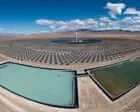
In the deserts of the United Arab Emirates a sprawling clean energy project, stretching across an area roughly the size of 12,600 football fields, will play host to a breakthrough allowing solar energy to power the equivalent of half a million homes through the night. The Gulf state has been steadily combining 5.2GW of solar power capacity with 19GWh of battery storage to create the largest battery scheme in the world. Meanwhile, about 7,500 miles away, at the US’s National Renewable Energy Laboratory facility in Colorado, researchers and engineers are making some of the smallest batteries the world has ever seen.
A fraction of the size of the grid-scale lithium-ion batteries used to store renewable energy, they have been designed to power electronic tags that will track the 3in-long (about 7.5cm) young from salmon and eel species. As traditional lithium-ion batteries push boundaries in size and scale, alternative battery types could provide the same vital role in harnessing low-carbon energy – but without the scramble for critical minerals such as lithium, cobalt and nickel that have raised concerns for environmental protection and vulnerable communities. Unlike lithium-ion batteries, which have a finite number of charge/discharge cycles, many of these alternative battery technologies can be used indefinitely and recycled when the units reach the end of their 20-year service life.
Already developers are turning to a large range of materials to store renewable electricity when it is available and use it to power everything from wearable technology to heating networks, factories and missiles. Here are some of the energy storage innovations raising eyebrows. Liquid air Late last year, on the site of a former coal plant in Trafford, the former mayor of Greater Manchester marked the start of construction on a long-awaited energy storage project that could usher in the “re‑industrialisation” of the county.
Andy Burnham said the development of the Trafford green cluster, which includes the Carrington “liquid air” cryobattery, could mean “this decade is the most exciting since the Victorian period for Greater Manchester”. In simple terms the Carrington project, developed by the British startup Highview Power, aims to capture renewable energy when it’s abundant and store it as liquid air. In theory, a “cryobattery” can store energy for hours, days or even weeks.
The science is more complicated: Carrington uses surplus renewables to cool air to -196C, which reduces it to a liquid one-700th of the volume. It can be kept in this state until renewable energy is scarce and market prices begin to rise. Then the liquid is allowed to become a gas once again, rapidly expanding through a turbine that generates electricity without the emissions typically associated with gas-fired power plants.
The project has faced a number of delays but once it begins operations, slated for the end of the year, it will deliver 300MWh of storage and an output of 50MW for six hours – or enough clean, renewable energy to power almost half a million homes. Molten salt While in Manchester energy is being stored at sub-zero temperatures, in the Nevada desert the opposite approach has been taken.








Comentários (0)
Entre ou cadastre-se para comentar.