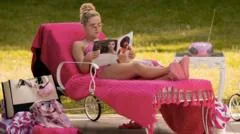
Legally Blonde revival Elle - boring and tedious or a hot pink delight? - Published Amazon Prime has taken on the daunting task of reviving a much-beloved noughties rom-com. What, like it's hard?
Well, apparently it is. The reviews are in for Elle, a TV spin-off of the cult classic Legally Blonde - and most of them are brutal. The Wrap slammed it as "boring and tedious", the Radio Times said it "should be illegal", and the Independent declared young people deserve better than the "slop" of "warmed-over revivals".
Not all critics were so damning, however - the New York Post celebrated Elle as a "sparkling good time" and NME, in a four-star review, calls it a "hot pink delight". Set in 1995, the eight-episode first season stars newcomer Lexi Minetree as Elle Woods, a high-school junior. When her family is forced to flee the blue skies of California for the grey clouds of Seattle after her plastic surgeon father botches a celebrity's nose job, Elle finds herself in a very different environment as she tries to navigate high school, friendships and romances.
With its neo-feminist message that you can be girly and kind but also shrewd and smart, the original Legally Blonde film was such a cultural reckoning that many of its iconic moments (bend and snap, I'm looking at you) are still referenced today. The movie catapulted Reese Witherspoon into the Hollywood A-list crowd, and, while she doesn't star in the revival, she is an executive producer. 'Half-baked' While the idea of pretty-in-pink Elle Woods being thrown into the grunge of 90s Seattle is "cute enough on paper", in reality it feels "thin and forced", wrote the Wrap's Marah Eakin, external.
Legally Blonde was "fun, fresh and brilliantly paced", she writes, but Elle is "dour, boring and tedious" despite its solid supporting cast, which includes James Van Der Beek in one of his final acting roles. Eakin also points out the show's cultural blind spots - Kurt Cobain would have died just one year earlier, yet none of Elle's Nirvana-loving peers seem to be aware of it. Similarly, would teenagers in Seattle during the mid-90s have used terms such as "victim-blaming"?
Perhaps not, suggested the Radio Times' Jack Seale, external. In his two-star review, Seale took particular aim at the screenwriting, pointing out that while there are moments of "peppy fun", the scripts seem to be "deliberately half-baked, as if the show isn't expecting your full attention". And maybe that's true - it's been widely reported that writers these days are doing so-called "second-screen writing" - effectively dumbing down plots so that viewers can still follow along, while simultaneously scrolling on their phones.
That doesn't mean that comedy should suffer, with Seale saying that every time a scene could deliver a "killer gag", instead it was just "gently amusing". "There are just so many moments here that could sing, yet they barely murmur," he wrote. It is as if the show isn't even trying to be funny, said Indie Wire's Ben Travers, external, because there aren't many jokes in the show, and the ones that are there are "too tepid".
Travers also criticised the plot for focusing on "tired teen drama, a pathetic love triangle and a lazy mystery".






Comentários (0)
Entre ou cadastre-se para comentar.