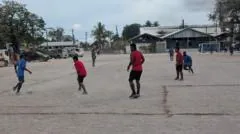
Like everywhere, the world's smallest island nation has been gripped by football fever for the past six weeks. But once Spain lifted the World Cup trophy on Sunday, almost every trace of football on Nauru stopped. Football is almost non-existent on this Pacific island.
Nauru has never fielded a team in an official international match and it has just one – hard sand – pitch. While there is interest in big Premier League matches, and children wear Lionel Messi and Cristiano Ronaldo kits, any attempts to actually play football tend to be mocked, unless it's Aussie rules. But things may be slowly changing as a group of volunteers - led by British former academy player Charlie Pomroy - seek to introduce the game to what was once the world's richest nation per capita but is now heavily reliant on foreign aid and has one of the highest obesity rates in the world.
A social media post from the Nauru Soccer Federation congratulating the new world champions and setting out a dream that "one day we hope to be in Spain's position" may have been fanciful, but the groundwork is real in what it says is the last country not to have had a senior international side. Laying the foundations, though, on an island where over-mining has left the landscape looking more like a moonscape, has been far from straightforward. Nauru has tried to develop football previously, but it has never really taken off.
The closest it has come to playing an international match was when representative teams faced a Solomon Islands expatriate team in 1994 and a refugee side in 2014. Its complicated past goes some way to explaining why the world's most popular sport has struggled for participation. Located in the Pacific Ocean 2,500 miles north east of Australia, Nauru's historical wealth was built on its vast deposits of phosphate from fossilised bird poo.
Nauru, which was a dependent territory of Australia until independence in 1968, was heavily mined in the late 20th Century. The minerals dried up, leaving the country once named Pleasant Island looking ragged, with large parts of its central areas uninhabitable and extremely challenging to farm. This resulted in most of the 12,000-strong population clustering around the coastal edges with usable space at a premium on an island that measures only 21 square kilometres.
And even that is shrinking, with climate change and rising sea levels threatening its very existence. Its barren land has left the country importing more than 90% of its food – much of which is processed, contributing to 69% of the population being classed as obese and around 40% having type 2 diabetes. One of its main sources of revenue now is from the Australian immigration detention centre it has housed for much of this century.
Everyday life on the island can be a struggle and sport has been a strong release for many, but the sport of choice is Aussie rules, which 30% of locals play. Also popular are athletics and weightlifting, which Nauru has competed in at the Olympics. Nauru will host the Micronesian Games in 2028 – a multi-sport event that includes football and will showcase the island's desire to grow its international reputation through sport.






Comentários (0)
Entre ou cadastre-se para comentar.