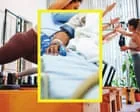
In January 2025, I attended my first bootcamp class. I had spent the day hunched over my laptop, anxious and craving an intense workout that would dispel my worries. I booked the class at a nearby gym, and the five-star reviews promised the all-consuming exercise I wanted: “Militant style instructor, but very motivating,” read one.
Another: “Hardest workout of my life; extremely rewarding.” The gym was no-frills – just a room with a mirror. After a standard warm-up, we did four sets of lateral shuffle push-ups across the floor, interspersed with standing, weight-bearing exercises. When my turn came, I dropped to plank position and started doing steady, shallow reps, focusing on my form.
But caution soon fell away. Upbeat music was booming and someone was always advancing beside me. When the instructor encouraged us to lower all the way down, I obeyed, even though my form suffered.
I had rarely done more than a handful of pushups at a time, and in the final set, I was exhausted, collapsing on every rep and barely prying my torso off the floor. The rest of class was a blur. I became nauseated, told the instructor I needed to pause, and stepped outside to suck cold winter air into my lungs.
Back in the studio, I sat on the sidelines and waited for the dizziness to recede before slinking to my spot for the core section and cooldown. Later that night, I felt what I thought was typical post-workout muscle soreness. I was satisfied; the ache was proof of a successful workout.
But the next day, lifting my arms to wash my face was exhausting. Searing pain kept me awake that night. Two days after the class, my arms were so stiff I couldn’t raise them more than a few inches, even to brush my teeth.
When I Googled my symptoms – pain, weakness and a new one, dark urine – something frightening came up: exertional rhabdomyolysis, a condition wherein extreme exercise causes muscle cell contents to flood the bloodstream, potentially overwhelming the kidneys. One article warned that debilitating pain after a new, intense activity was a sign to visit the emergency room. I went to the ER but suspected I was overreacting.
After all, the internet always offers the worst possibility. Doctors use bloodwork to test for exertional rhabdomyolysis; typically, they diagnose it if a patient has too much of a muscle enzyme called creatine kinase (CK) in their blood – at least 1,000 units per liter, or five times the normal range. However, there is little consensus on this number, says Dr Barry Boden, an orthopaedic surgeon at The Orthopaedic Center in Maryland, who specializes in sports medicine.
Some recent guidelines suggest that only higher amounts – as much as 10,000 units – warrant diagnosis and inpatient treatment. My CK count was so high the machine in the emergency room couldn’t measure it; a nurse had to do a second blood draw and send it to a more precise lab. They put me on an IV drip and eventually reported the exact number: 57,000.
Thus began my seven-day hospital stay. My mom and sister traded shifts, acting as my arms for the week – scrubbing my teeth, feeding me, washing my face. I had never felt so helpless and irresponsible.









Comentários (0)
Entre ou cadastre-se para comentar.