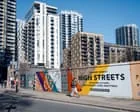
Diana Sach once employed more than 30 people and catered for hundreds more every day from her Latin American restaurant and delicatessen, famous for its Peruvian empanadas, in south London’s Elephant and Castle district. Now, she looks longingly at the shiny tall buildings that have replaced the brightly coloured but shabby shopping centre that was her home from home before being demolished in 2021. “I hoped to be part of it.
But there has been delay after delay and now I can’t see how it will happen for me,” says Sach. The Elephant, which will this month welcome its first commercial tenant – the matcha-serving Blank Street Coffee – and where residents are due to move in later this summer, is part of a £500m redevelopment of the south London landmark once renowned for its urban deprivation. A modern town square surrounded by tower blocks has replaced the old shopping mall – a brutalist fortress surrounded by spooky underground walkways and tunnels, which was one of Europe’s first large indoor shopping centres when it opened in 1965.
It is the latest step in the multi-billion pound reinvention of the area, which has seen the neighbouring Heygate housing estate demolished and rebuilt as modern towers, with shops and eateries on the ground floor, surrounding a leafy park. The opening of the Elephant, which includes about 40 shops, restaurants and bars as well as a cinema and gym, a new home for the London College of Communication, 55,000 sq ft of offices and hundreds of flats – all watched over by the former centre’s distinctive statue of a pachyderm carrying a tower on its back – marks a new start for the area after years of construction. The regeneration plan has been the subject of wrangling between local people, the council and developers since the 1990s, with residents nervous that their needs would be steamrollered along with the mall in favour of gentrification.
It is part of an ongoing battle across London, and other UK cities, between communities and redevelopers. Oli Mould, professor of social, cultural and historical geography at Royal Holloway, University of London, says the redevelopment of Elephant and Castle, which began with the razing of Heygate, is almost “‘patient zero’ of London’s gentrification.” “A lot of these processes happen quite fiercely and quickly in London then spread across the country,” he says. Mould suggests the new development has created an “identikit homogeneous gentrified place”, which risks “destroying the very thing that makes a community thriving and beautiful in the first place”.
Sach, who came to the UK from Colombia 30 years ago, is not alone in feeling there is no place for her in the Elephant development. She says the developers, Get Living, and Southwark council have failed to honour promises that her restaurant would find a new home. She and the 90 displaced Latin American businesses that brought colour to Elephant and Castle were told there would be adequate temporary accommodation for them to maintain their businesses during construction.
But only a handful found a new place to trade on the temporary site. For the restaurant and cafe owners, the shoe boxes on offer within a stack of metal containers, now set to be dismantled, proved unviable.







Comentários (0)
Entre ou cadastre-se para comentar.