A solar eclipse as seen from the La Silla European Southern Observatory in Chile MARTIN BERNETTI/AFP via Getty Images A total eclipse occurs somewhere in the world about once every 18 months on average, and that has been the case for all of human history. For millennia, humans have been documenting their views as the moon moved between Earth and the sun, blocking out the sun’s light and revealing its swirling outer layers. National Park Service The earliest confirmed written record of a solar eclipse comes from the 13th century BC, when scribes in China wrote that the sun had been “eaten”.
Scientific and religious texts continued to document eclipses up until the present day, and researchers now use these texts to study both how eclipses have changed in the intervening centuries and how human views of them have evolved throughout time. This particular petroglyph, carved into stone by the early Pueblo people in New Mexico, is thought to represent a total solar eclipse that occurred on 11 July 1097. The swirls around its perimeter bear a resemblance to the corona of the sun, which is only visible when the moon hides the rest of the solar disc.
Cci/Shutterstock More recent art depicts religious and scientific figures observing eclipses directly. This watercolour from the late 17th century shows a group of French missionaries observing a solar eclipse with King Narai of Siam and his court in April 1688. They can be seen using the projection method to avoid looking directly at the sun: the light passes through a telescope and projects the shape of the eclipse on a screen beneath it.
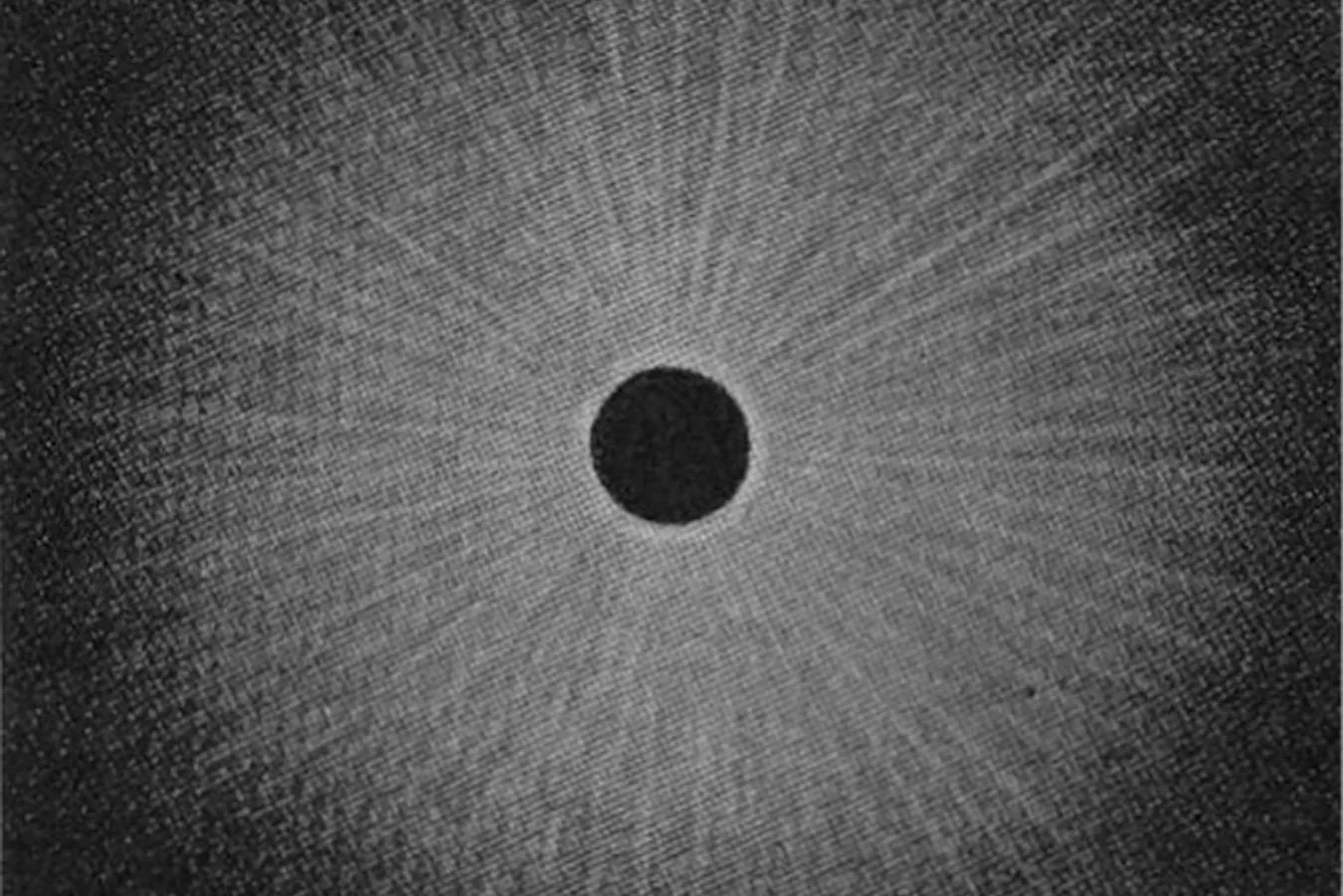
This technique is still commonly used today, with pinhole cameras or even just the gaps between shadows cast by leaves on the ground. Advertisement José Joaquin de Ferrer Scientific sketches of eclipses proliferated as science became more of a formal, professionalised pursuit. This drawing, by astronomer José Joaquín de Ferrer, depicts an eclipse that occurred over New York on 16 June 1806.
Watching this event led de Ferrer to give the outermost layer of the sun, the corona , its name. He was among the first people reported to have hypothesised that the corona must be part of the sun, not the moon, because of its incredible size – it can stretch to as much as 20 times the width of the main disc of the sun, as he sketched here. Johann Julius Friedrich Berkowski The first photograph of a total solar eclipse with enough detail on the corona to be scientifically useful was taken on 28 July 1851 by Julius Berkowski at the Royal Observatory in Königsberg, Prussia.
With help from the astronomers at the observatory, he attached a small telescope to a device called a heliometer, a specialised instrument for measuring the sun. This daguerreotype was an 84-second exposure taken through the telescope. Not only is the corona visible, but several eruptions can be seen blasting from the sides of the sun over the edge of the moon.
William Langenheim; The Metropolitan Museum of Art After Berkowski’s image, the ability to take photographs of eclipses became more widespread around the world. These images were taken by William and Frederick Langenheim on 26 May 1854 in Philadelphia, Pennsylvania.








Comentários (0)
Entre ou cadastre-se para comentar.